Monday, October 20, 2014

Is Religious Freedom really in the name of God?

Bethany Garland

It seems these days with all of the controversy going around with same-sex couples getting equal rights as the rest of the public, it makes all Christians seem very intolerant, but is that really the case? The supporters for these "legal discrimination" bills are always labeled as the 'religious right' of America. That makes it seem that if you're religious you are supporters of this type of legislation and thrown into a bad light with the real supporters. In a very simplistic but intriguing article Benedictine Sister Joan Chittister wrote an article for the National Catholic Reporter discussing the issues of homosexuality and their rights here in America. She does a great job using ethos, pathos, and logos to pull the reader in and keep them until the very end.

Sr. Chittister does a great job of grabbing the readers attention at the beginning by addressing what is wrong with religion, and what two kinds you are likely to run into. Using a little bit of humor she explains both kinds saying, "You never know which religion you are going to meet: the,'Do unto others as you would have others to do unto you' kind or the 'Get thee behind me, Satan' kind." (Chittister 28) She then starts laying out facts about the one who like to discriminate, giving historical examples of some of the segregation and deaths those led too, all while supposedly being done in the name of God. She talks about the bill in Arizona, criticizing the group that pushed for it, writing, "We have a new group developing, just as deadly, just as 'religious' as the ones that preceded it. This new group made their first great public move in Arizona in February, just after the country, in a great sweeping gesture of goodwill last fall, had voted against discrimination on the basis of sexual orientation." (Chittister 28) Using facts and reason with emotion laced in the argument gives the piece such a compelling component.

Most of the authority that Sr. Chittister has goes along with her title. Having a nun write an article in a Catholic periodical allows the reader to have a sense of trust even before reading her work. Homosexuality is a huge topic in the Catholic community and a majority of Americans believe the Church casts out and distances itself from those who are openly gay. In reality it is the total opposite and Sr. Chittister does a great job showing how accepting that community can really be. "So now, the exclusionists whose 'religion' defies the very principles of the God who created the others as well as themselves are working again to sequester and silence those who are other and want services the rest of us take for granted in the public square." (28) Even Pope Francis talked about it this summer, "'If someone is gay and he searches for the Lord and has good will, who am I to judge?' Francis told reporters, speaking in Italian but using the English word 'gay'." (Donadio, Rachel) She makes it known that she has no selfish motives for writing this article and is also very well educated on the topic. She is what religion really should be about, excepting and loving our neighbors, with out judgment or segregation.


Works Cited

CHITTISTER, JOAN. "Don't get complacent, there are more." National Catholic Reporter 28 Mar. 2014: 28. Academic Search Premier. Web. 21 Oct. 2014.

Donadio, Rachel. "On Gay Priests, Pope Francis Asks, ‘Who Am I to Judge?’." The New York Times 29 July 2013. The New York Times Company. Web. 20 Oct. 2014. <http://www.nytimes.com/2013/07/30/world/europe/pope-francis-gay-priests.html?pagewanted=all&_r=0>.

Wednesday, October 15, 2014

RFRA Protects Hobby Lobby

Bethany Garland

Sotomayor
Kagan
Ginsburg
Breyer
Kennedy
Roberts
Scalia
Thomas
Alito
In a 5-4 Supreme Court decision, it was ruled that the craft store chain Hobby Lobby does not have to cover the cost of contraceptives under Obamacare for it's employees. Now, Obamacare has a mandate that says employers have to pay for the insurance to cover the cost of contraceptives for women, so what makes Hobby Lobby different? The Religious Freedom Restoration Act of 1993."The Supreme Court ruled on Monday that requiring family-owned corporations to pay for insurance coverage for contraception under the Affordable Care Act violated a federal law protecting religious freedom."(www.nytimes.com)  Luis Granados authored an article, The Real Hobby Lobby Problem, detailing his views on why RFRA needs to be repealed. Granados did an exceptional job using ethos, pathos, and logos to spell out why RFRA doesn't work for this country and why we as a nation would be better off without it.

Luis Granados didn't go over the top with his emotional stand point, which speaks volumes to his character. Since he uses more logos and ethos to get his point across it was appropriate to not go overboard with pathos. He did show his passion for the topic using humor through out the article stating, " And the law as it stands includes my nominee for the single worst statute on the books today, the Religious Freedom Restoration Act of 1993." (Granados, Luis) He was able to show his distaste for RFRA and later in the article showed how he felt about the politicians who passed this bill. "Democrats, the as now, envied the power of the religious right, and then as now deluded themselves into thinking they could win over a fair share of evangelical voters by sucking up to organized religion." (Granados, Luis) Using his humor but not going over the top he was able to grab his audiences attention and allow them to think about his point-of-view even if they didn't agree with it.

Along with using his humor to grab the reader's attention, Granados establishes trust with his use of facts, and the reasoning behind them. Logos and ethos go hand-in-hand in this article. Since this work is such an opinionated piece, it is very important for the author to use both to keep the audience until the very end. In the article, Granados explains his reasoning for why he feels like the RFRA doesn't belong in this country, but he doesn't stop there. He goes after not only the 'religious right' but also the Democratic politicians. He claims their motives for passing the law were to grab more votes from the 'right side'. He also blames the writers of Obamacare for their carelessness when allowing a third of the population to be exempt from so-called mandates because of religious views. Then at the end he uses common sense and a little humor to wrap it all up saying, "Have one government with one set of laws that applies equally to everybody, regardless of what they do or don't believe about the supernatural." (Granados, Luis) What he does so ingeniously is make the audience as a whole, no matter what their beliefs are, stop and really think about the law and whether we do really need this protection.

Works Cited

Granados, Luis. "The Real Hobby Lobby Problem." Humanist 74.3 (2014): 6. MasterFILE Premier. Web. 16 Oct. 2014.

Liptak, Adam. "Supreme Court Rejects Contraceptives Mandate for Some Corporations." The New York Times 30 June 2014. The New York Times Company. Web. 16 Oct. 2014. <http://www.nytimes.com/2014/07/01/us/hobby-lobby-case-supreme-court-contraception.html?_r=0>.

Monday, October 13, 2014

Religious Freedom Restoration Act; What Has It Created?

Bethany Garland

Employment Division v. Smith was a case heard in the Supreme Court after 2 members of a Native American Church were fired and denied unemployment services because they tested positive for peyote, which they used in a religious ceremony. As a reaction to that ruling Congress and President Bill Clinton unanimously agreed and signed the Religious Freedom Restoration Act into law in 1993. With all the controversy happening today, such as Hobby Lobby refusing to pay for their employees to use contraceptives or SB 1062 in Arizona, is it time to repeal RFRA? Katha Pollitt, a writer for The Nation thinks so with her article, "Too Much Religious Freedom?" Using pathos, ethos, and logos she clearly states her views and holds nothing back which makes the article seem a little distasteful.

Pollitt ruined her authority on this subject with there sheer obnoxiousness that she uses when writing this article. She doesn't show any respect for any other views then her own and at sometimes belittling the values some readers might hold like when she said, "Two decades later, it’s clear that the main beneficiaries of RFRA are the Christian right and other religious conservatives." (Pollitt, Katha) She didn't use any other sources when writing the article and her motives were never made clear until one of the last sentences where she says, "The Religious Freedom Restoration Act needs to be repealed, but it is hard to see where the political will is going to come from."(Pollitt, Katha) Overall her use of ethos was ineffective and hard to identify.

Coinciding with her inability to establish any authority she uses some facts to back up her beliefs. With every claim she made she cited a lot of different court cases that have been in the resent news. Everything from Hobby Lobby refusing to pay for contraception, "The Supreme Court ruled Monday that certain "closely held" for-profit businesses can cite religious objections in order to opt out of a requirement in ObamaCare to provide free contraceptive coverage for their employees." (foxnews.com) To a nurse, Sara Hellwege, suing a family planning clinic who didn't hire her because she didn't believe in birth control pills."Hellwege is a member of the American Association of Pro-Life Obstetricians and Gynecologists, and told health center staff that she would not be willing to prescribe birth control if she were hired for the job."(huffingtonpost.com) Pollitt even wrote about a law similar to SB 1062 that passed in Mississippi allowing businesses to refuse service to people based on religious beliefs. The whole time insulting every side of these cases she didn't agree with.

Pathos was the one appeal in her argument that she used well, and a lot of. She never held anything back when it came to how she felt about RFRA. With statements like, " In the not so distant future, it's entirely possible that religious freedom will be the only freedom we have left-a condition for which we can blame the Religious Freedom Act of 1993," (Pollitt, Katha) and "RFRA, which required laws infringing on religious convictions to meet the 'strict scrutiny' test, was overkill." She was able to show how passionately she hated RFRA and the reasons behind them..


Works Cited

Pollitt, Katha. "Too Much Religious Freedom?." Nation 299.7/8 (2014): 10-11. Academic Search Premier. Web. 14 Oct. 2014.

"Supreme Court Rules ObamaCare Provision Can't Force Some Employers to Cover Contraception." Fox News 30 June 2014. Fox News. Web. 13 Oct. 2014. <http://www.foxnews.com/politics/2014/06/30/supreme-court-hobby-lobby/>.

Bassett, Laura. "Anti-Contraception Nurse Sues Family Planning Center For Not Hiring Her."HuffPost Politics 21 July 2014. The Huffington Post. Web. 13 Oct. 2014. <http://www.huffingtonpost.com/2014/07/21/anticontraception-nurse-s_n_5606912.html>.

Thursday, October 9, 2014

SB 1062, Does it Effect More than Religious Freedoms?

Bethany Garland

Thinking about what effect "anti-gay" legislation would have on people, I started to wonder about the economic stand point of the bill. Would it negatively effect Arizona's economy, or would it not have any impact because Gov. Brewer vetoed the bill. Hillary Davis, a staff writer for Inside Tucson Business explored this topic after the veto came down. She discovered that while it did have a negative impact on Arizona's image, it would be a while before anyone really knew if it would be an economic disaster as well. She did a great job using logos and ethos, but the article lacked any type of emotion to it. 

Davis used a lot of facts and reasoning in her work, allowing the audience to get a sense of credibility from her. She showed that she did indeed do a lot of research on this topic even though she came up with no clear answer to the economic question.  " Be quick, be firm, be proactive and be unified against laws that can hurt tourism—an industry that accounts for 200,000 direct jobs in the state and more than $19 billion in annual spending, according to the Arizona Office of Tourism."(Davis) . This kind of language is an example of how she uses facts but really the article lacks anything concrete when it comes to showing the facts on a loss of business. 

With ethos she uses other people and what they have to say concerning this issue to establish authority. Most of her information came from three main sources, Brent DeRaad, president and CEO of Visit Tucson; Kristen Jarnagin, Senior Vice President of Arizona Lodging and Tourism; and finally Stacy Murillo, director of public relations and communications for the Arizona Business Travel Association. They add authority to the article because of their positions and titles but they all say the same thing, which is you have to wait and see what the effects will be. 

The article definitely lacked pathos. There was little to no emotion in the paper at all. It was very cut and dry as far as what the economy could do, but we would just have to wait and see. She should have gone into detail about the different business that wouldn't relocate to Arizona like they were planning to if the legislation made it into law. Also to add some emotion she could have discussed how the Super Bowl Host Committee wanted to move the upcoming Super Bowl out of Arizona, which would have made a huge impact economically. "The host committee for next year's Super Bowl warned Arizona Gov. Jan Brewer (R) not to sign the controversial anti-gay bill known as SB 1062, warning that such a move would 'deal a significant blow to the state's economic growth potential' ahead of the big game." (www.huffingtonpost.com) A lot of business were counting on that for tourism income and that stirred up a ton of emotion. 
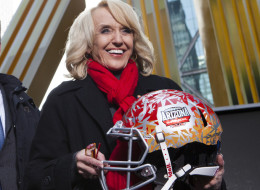
Arizona Gov. Jan Brewer (R) is under pressure to veto SB 1062. (Photo by Christopher Gregory/Getty Images)
Overall she did get her point across, that we would have to wait to see if this will have any impact economically on the state of Arizona. There wasn't a lot of substance there in the article to think that it was exceptionally written. To gain my attention the article should have shown more passion about the possible side effects this bill could have on the state. And how it damaged our state's image costing a lot of money on tourism. Also there were a few grammatical errors that also led me as the audience to think there wasn't a lot of time put into it.


Works Cited
Davis, Hillary. "Economic Effect of SB1062, If Any, Won't Be Known For Months." Inside Tucson Business 23.38 (2014): 4. MasterFILE Premier. Web. 10 Oct. 2014

Turkel. Amanda. "Super Bowl Host Committee Condemns Arizona's Anti-Gay Bill SB 1062." 25 Feb. 2014. The Huffington Post. Web. 9 Oct. 2014 


Wednesday, October 8, 2014

The Real Victims of SB1062

Bethany Garland

A bakery owner is asked to bake a wedding cake for two women who are about to get married, the owner wants to decline the request because it goes against their religious beliefs but they don't for fear of being sued by the couple. Two women are excitedly planning their wedding and they find a bakery they want to use to make their cake, but the owner declines because she religiously doesn't believe in a wedding between two women, so the women now have to find a bakery that won't turn them down because of who they are. So who is the real victim in these situations, the bakery owner or the gay couple?  That is exactly what Patrik Jonsson discussed in his article "Arizona 'religious freedom' bill: Attack on gays or shield for some Christians?" published in Christian Science Monitor. In his work he explains this with mindfulness of both sides, careful not to show one side as any better than the other, using logos, pathos, and ethos.

Starting with the most prominent in his article, Jonsson uses a lot of fact and reasoning to explain how both the religious right and the LGBT community could both be seen as victims depending on whether or not SB 1062 went into law. For the religious right he states "Religious conservatives say Democrats are being hyperbolic about the bill's possible impact, suggesting instead that the real issue is about current law--and the courts--discriminating against the private beliefs of religious individuals."(Jonsson, Patrik) He then counters that with what the left side believes writing, "The Arizona legislation has sparked outrage from the primarily gay rights activists and Democrats, many of who say the proposal would enshrine some kinds of discrimination and has 'no role in a modern society', as state Senate minority leader Anna Tovar(D) said in a statement." This shows how black-and-white he is when explaining how each side feels victimized.

The emotional side of this article comes from how passionately each side feels about the issue and how they both feel as though they have been wronged. He cites House minority leader Chad Campbell in his article to show the intensity of the issue. Campbell said, "We're telling [gays], 'We don't like you. We don't want you here. We're not going to protect you.'" Just like with logos, the author comes back and counter with what Rep. Eddie Farnsworth, who sponsored SB1062 is saying. "We're making some tweaks[in Arizona] because of what's been going on in other states where people have been punished for their beliefs." This shows also how Jonsson is careful to represent both sides equally.
  

Finally, Patrik Jonnson using ethos tries to convince his audience that he has some sort of authority to write this article. This is the one that he did the worst on. By representing both sides equally and having a counter argument to what he writes shows that he isn't really on any side. He definitely did his research before writing this piece and that is his one saving grace when it comes to using ethos. An example of that is he states specific examples of cases happening in the country to show that there might be good reasoning behind this bill. Writing for a Christian Science news organization might lead the audience to believe the author had an opinion on which side is really the victim but that definitely wasn't evident.

Patrik Jonsson didn't do that great of a job in this article using logos, ethos, and pathos. He  never really showed that he leaned one way or another on who is being hurt more by this legislation. For every point he made on behalf of one side, he countered with an equal point for the other. In the title of his article he asks the question of whether this is an attack on gays, or if it indeed is protecting some religions but never answered his own question. 

Works Cited
Jonsson, Patrik. "Arizona 'religious freedom' bill:Attack on gays or shield for some Christians?." Christian Science Monitor 21 Feb. 2014: N.PAG. Academic Search Premier. Web. 9 Oct. 2014